


More Horrible Art
- Aug 28, 2020
- 10 min read
Updated: Sep 21, 2020
Allow me, in the least seductive way imaginable, to tempt you into reading another large post about art. Art which is creepy, spooky, horrible or just plain old traumatic. In my first post about art some of the pieces may have been a more depressing kind of "horror". One that creeps into your soul like overgrown vines. I will endeavour to lighten the fuck up on this post. Think of this as the Halloween edition. Spooky, but fun. Or not fun, but you won't spend an hour afterwards staring at a blank wall and thinking about your own inevitable death! Hopefully...
There can be something spooky lurking in everything. I should know, I have anxiety. I don't even have to try hard to find the scariest possible outcome of every situation known to man. Example: I don't remember the last time I peed without thinking I was dreaming and actually peeing my bed. That kind of dissociative, "horror in the everyday" kind of feeling is my life.
And so, when your whole life has been horror, and it continues to be, you have to find the fun in the horror. You have to, in the wise words of Melissa Arnette "Missy" Elliott, flip it and reverse it.

To a detrimental extent, I can look at any scenario, any event, any situation, and frame it like a little horror film. What could go wrong next? How would I escape this room? What's in that scary tiny cupboard over there in the corner? So it's to no surprise that I can feel the fear in a painting, even when it may not be palpable enough that a painting is regarded as spooky.

This is why I enjoy the works of Edward Hopper so much. I could something spooky in even a Norman Rockwell piece, but Edward Hopper leaves so much room for my imagination. It's like he's invited it in. A vast, desolate space left on his canvas. The potential for thoughts to intrude. For your mind to place something there that you desire to feature in the painting. Or rather, don't.
And, before you come at me for being selective of my choice in works, Edward Hopper is the big daddy of the themes of isolation and loneliness. A few of his more impressive feats of displaying this solitude in works feature deeply lonely humans at natural gathering places. At the cinema, at a restaurant, in the city, with your loved ones, with your maybe-not-so-loved ones. Even his buildings seem lonely despite their inability to 'feel'. Although please read my post on haunted architecture for my thoughts on a house's ability to express emotion. The deep-seated sentiment of 'alone' pervades everything in his paintings. His works exude a sensation of deep solitude. So desolate are his landscapes, yet so intricate and welcoming.

Loneliness is endemic in Hopper's work. I welcome it. When I started writing this post I thought to myself, I cannot do another large selection of one artist's works. This post will be about single images, I confirmed. And then I remembered how much I love Edward Hopper. How much I have to say about him, his works. How much his houses, specifically House By The Railroad, make me nostalgic for a life I've never led. Make me shut my eyes, dreamily, pretending that I'm at Cape Code. Or sitting on the beach at Martha's Vineyard, pretending I don't know what the Kennedy's are up to. They're good neighbours after all!
The loneliness is enough to conjure up deeply personal feelings. So let's jump into what are some strong representations of women and their place in the world. A lot of Hopper's paintings feature women in these empty rooms with the isolated backdrop. And even when the women aren't alone, they resonate with me most. I find their features easily recognisable, relatable. Although, disclaimer, I do identify as a woman, and always have, so I'm reading this from my perspective.

Women, like the matriarch of Cape Cod Evening tell such an interesting story within the paintings. And it plays well with the narrative of their surroundings, or at least, the narrative I've made for it. The house, seemingly in the middle of a field of tall grass, has no path leading to it. If anyone wanted this family, they'd have to really desire some form of contact with them. The creeping forest intruding on the house, gently brushing the windows with it's branches as though trying to reclaim this small spot. An undetermined mad, sitting as a secondary subject. Our woman, reserved, careful. Withholding from her family unit, or bracing herself against an external source. Her face, telling of her unhappiness, of her doubt, anger and unsure mind.

Women, like she of Cape Cod Morning, who is longing for something. Again, alone, surrounded by nature. Encapsulated in her bay window, as though being viewed in a display case. Are we, the viewers, the paying public at this exhibition of "the lonely housewife", or is there someone else. Someone that is drawing her attention. Someone standing at the other end of that field, encroaching on her home, within her private property. Someone who she has watched get closer and closer. She looks tense, scared. Of standard Cape Code life? Or her Lucy Jordan-esque place in society? Or a threat only she is able to see.

And, of it's time and ours, women like the victim of Night Windows. An all too familiar trope, the male gaze. A woman, vulnerable in her undress, at the mercy of a peeping Tom. Someone, taking advantage of a private space. A victim, unaware of her predator. A space that is uncomfortable for those who are placed in the direct line of that gaze. As it should do. I feel unreasonable, rude. Illegal? A classic horror story, all too real for women. It's easy to associate this piece with a contemporary male gaze. We can easily excuse this as an accidental glance. As a misunderstanding. But should we? That's where the unease comes in. The horror of real life. The horror of existing as a woman.
Hopper's women are the true windows into the society of his time. They visit motels, they go to the theatre, they bask in nature's glory, they travel. Living their lives independently in pride, but exhibiting sadness. They are thoroughly modern, yet completely classic. Timeless characters who, in their silence and abject loneliness, capture how it feels to be vulnerable in society, and how it can feel to be female. I think Hopper's women go hand in hand with those of Shirley Jackson, strong yet disquieted. A part of society, but on the very fringes of it. Allowed to be but not participate. It is this crossroads of gender and everyday dread of existence where Hopper meets horror.
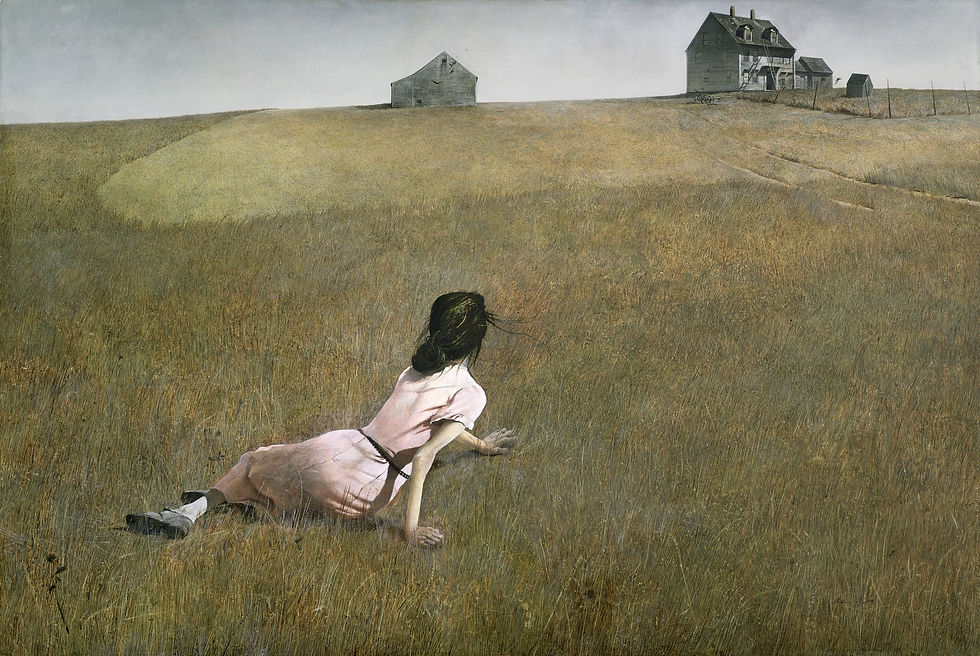
Speaking of women in isolation, I get the same vibes of sadness and longing from Andrew Wyeth's Christina's World. It's haunting, in history and imagery, and allows us to place our own fears into the vast landscape. But it's not the painting I find the eeriest.

Andrew Wyeth, at a point in time where his own life and inevitable death were playing heavy on his mind, painted a storied portrait of a long-dead captain. The skeleton sits on a plain chair, looking out of the ship's windows, nothing but bones and a regal jacket. Inspired by the once-loved fictional character Dr Syn, Wyeth delivered a twist on self-portrait. The jacket worn by the captain is one Wyeth's father featured in his illustrations and passed on to his son. The bones were drawn from an x-ray of Wyeth's own body. It's an unusual subject matter for Andrew Wyeth. He is better known for his sweeping landscapes and subtle farmhouses. One who captured the beauty and strength of spirit, but ultimate loneliness of condition with Christina's World.
But this 'dark matter' took hold of Andrew Wyeth's son, Jamie Wyeth. In his own right, Jamie is an extraordinary artist. Take, for example, his portrait of his father Andrew. It's a beautiful piece touched with extreme contrasts in light and dark. You can sense their relationship and symbiotic creativity in it. And Wyeth's other portraits are equally captivating, like his work on Andy Warhol. And let us not forget his best piece, A Very Small Dog. It's an image that gives me life, and it did get a fair amount of popularity recently due to a tweet, so you may have hear dof it. His works speak to me more than his father's based on subject matter alone. He gets ooky spooky with it. Jamie goes all in with the Halloween town imagery, and relishes in the festively quirky at times. Even his take on the navy captain's jacket, which he has inherited from his father, features in his own unique style of nerve-inducing coastal horror.

In his works, Wyeth features that staple of all things spooky. The symbol of Halloween, the mascot of horror. Pumpkins. The whole of the Wyeth family seem to enjoy painting Pumpkins, but Jamie's works embody the cheeky spirit of them best. Mischief Night features a pumpking poking his cute, little head out of a basket on wheels. On his way to wreak havoc and provide the tricks to accompany the treats. His branches reach out like spindly fingers, pushing the ground and providing frenzied motion to the journey, and to the painting.

These pumpkins seem pervasive in Wyeth's art. They crop up for absolutely no reason sometimes. Inspired by Wyeth's dedication to Monhegan Island and his stays there in late Autumn, the pumpkins bring a gentle and very fun spooky element to a painting where they wouldn't normally belong. In The Headlands of Monhegan Island the tumbling pumpkin heads strike an exciting image. It seems like the promotional poster for a super kooky, straight to DVD Halloween movie where a sleepy, coastal town is invaded by some malicious, determined Pumpkins. Think Attack of the Killer Tomatoes or Rubber..
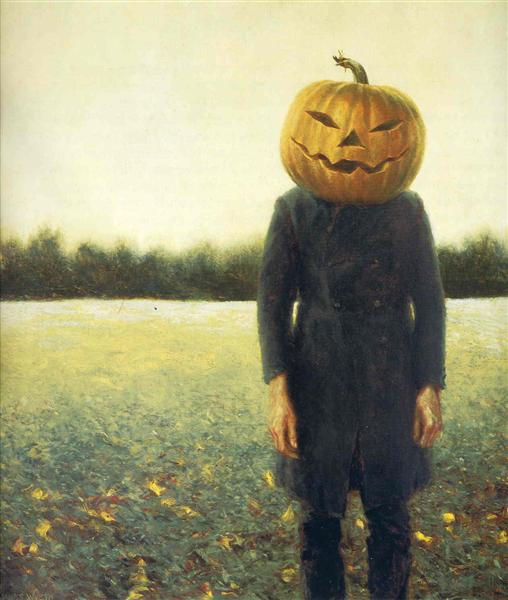
And while classic, and therefor comical, in their appearance, his pumpkins serve as representatives of Wyeth and his work. In his self-portrait, Pumpkinhead Wyeth wears all black and stands in a field. He has become one of the pumpkins. A tall figure, encapsulating those standards of the genre, working his way into our nightmares with his jagged, questioning grin. The fun of horror is here. Something completely innocuous, a staple of everyday life, a familiar object. But turned on it's head it brings unease. I'm waiting on a jump scare. I want to know the story of this exemplary main character. I want to know the reason for his existence. I know him, I recognise him. And I think all horror fans can relate to this image. It's borderline nostalgic, reminiscent of a classic film, a Goosebumps book, the image of Michael Myers.

Jamie Wyeth's pumpkins are staples of his work, and they are the perfect embodiment of the Halloween spirit. There are a lot of pumpkin works by Wyeth which I couldn't find sources for (or titles for). I was hesitant to include them here despite them being convincingly in his style and of his oeuvre. But, there are still plenty to pick from. And you can see an interesting collection of pumpkin themed works by the Wyeth family, including two wonderful paintings; The Runners and Mischief Night.
And in keeping with the classic themes of horror, what would the genre be without death? It is an integral part of most horror films. Exploited and forced on to us, we're reminded that it can hunt us, that it will come for us whether naturally or by the hands of a malicious entity. And, ultimately, death personified is the main character at the end of our lives.

The Grim Reaper is an understated feature of the 1893 painting, Premonition by Henryk Weyssenhoff. But once you notice him, he's hard to ignore. This, for me, is as close to classic and realistic a portrayal of death as I can imagine. Death is there, and yet in our attempts to ignore it, it becomes almost invisible to us. But it walks our streets, past our peaceful houses where we conceal and protect our living. The classic trope of animals being aware of the supernatural features in Premonition. The dogs raise their heads to the sky, taking their warning howls of the arrival of death in this quaint environment to the winds in hopes it will travel. They're not in attack mode, they're signifying the arrival. They're closer to the natural order of things, to the understanding of the inevitability. But the people, lights on and warm smoke rising from their chimney, are blissfully unaware. As we like it.
But when we are more aware of death, what happens to us? What does it feel like to be acutely aware of one's mortality? To know that nature isn't waiting for our death, it expects it? As someone with an anxiety disorder, the waves of fear that come out of nowhere and submerge you in paranoia serve as a reminder of your heart beat, your breath, and your fleeting existence. That I can be with friends, loved ones, in a familiar place that makes me happy. Only to have it pulled away by a sudden, overwhelming feeling of heart wrenching dread. That's what the end is, what true terror is. And it makes me want to scream.

"I was walking along the road with two friends – the sun was setting – suddenly the sky turned blood red – I paused, feeling exhausted, and leaned on the fence – there was blood and tongues of fire above the blue-black fjord and the city – my friends walked on, and I stood there trembling with anxiety – and I sensed an infinite scream passing through nature." - Edvard Munch on The Scream
Edvard Munch so succinctly captures my feelings of a panic or anxiety attack when describing his inspiration for his most famous painting, The Scream. So deftly does his painting capture that inner feeling of absolute horror, the disassociation of unidentifiable worry where your surroundings and those around you are completely unaware of what you can sense. Unable to understand or help. It feels like you're taking on the world, that you alone are burdened with the knowledge that everything is not ok, that everything is coming to an end.
In his diary, Munch also wrote "One evening I was walking along a path, the city was on one side and the fjord below. I felt tired and ill. I stopped and looked out over the fjord—the sun was setting, and the clouds turning blood red. I sensed a scream passing through nature; it seemed to me that I heard the scream. I painted this picture, painted the clouds as actual blood. The color shrieked. This became The Scream." That's it, the answer to the painting. The answer to my anxiety. There is no specific reason for it, either internal or external. It is everything and nothing. It is simply the act of living. Walking with friends at sunset or alone on a cold morning. Being alive is the true horror. And sometimes, you just need to have a good scream to vent it and continue on, happy.
For more horrible paintings, please read my first post on art!


Comments