


Haunted Architecture
- Aug 9, 2020
- 13 min read
Updated: Jun 6, 2022
I'm going to talk to you about houses. (Mild language warning included!)
I love houses. Architecture makes me happy. The way a building looks, the curb appeal, the shape of the roof, the way the windows and doors complement each other. Everything about it makes me delighted to my core. Every type of architecture has it's beauty and strong points in my view. I take as much delight in the intricate whimsy of Victorian homes to the strong and fashionable straight edges of Bauhaus. While in my youth I wrote an essay comparing the virtues of Gaudí to what I had then viewed as the failures of Lloyd Wright, I now aspire to have a carport. Opinions change!
While my favourite architectural style can heavily depend on my mood that particular day, I hold a long-standing appreciation for a lot of American architectural styles. That aforementioned mid-century modern feel was really done best in America, and even when they take a turn at mock-styles, American architectures are great at encapsulating the particular styles they are emulating in a appreciative and nostalgia inducing way. I even enjoy looking at McMansions, though more to laugh than in an appreciative sense.
So guess what else I love? Haunted houses! Houses take on a particular feeling. That's every house by the way, not only the ones that look evil. Even sceptics and non-believers have to admit that they get that feeling when something just isn't right. Where your animal instincts kick in and you trigger your fight or flight. You can get that feeling in a new-build home! A house doesn't need a basement built over an ancient burial ground in it's blueprints. It's the kind of sensation you get when a place isn't lived in. And, if you'll forgive me a more paranormal sentiment, a place can definitely retain a negative energy. Whether that energy can touch you, haunt you or appear as a full body apparition is another thing entirely.
This kind of energy is best explained by The Stone Tape Theory. (And yes, I will cite Wikipedia. It's the biggest con of our time that teacher's have led us to believe it has no valid worth). It posits that ghosts are in a sense residual hauntings. That the literal bricks of our homes, the very materials that they are made of are capable of recording our words, our actions and our very essence. Have you ever wondered why you can't interact with some ghosts? Or why some ghosts are reported to repeat the same actions over and over again? Why some of them can seemingly walk through walls etc.? The Stone Tape Theory explains this. They're a recording, something that the space itself is playing over and over again. You can't interact with it anymore than you can the characters of a film, no matter how much you plead them to not investigate the strange noise in the room at the end of the dark hall.
I like this theory. It's a bit more Gothic, an explanation which holds more aesthetic weight in my mind.
Of course, ghosts and spirits would be different under this theory. And while it doesn't directly address spirits who can contact the living, it does give more credence to the concept of a haunting. The idea that a place can be haunted by it's past, as the living can be too. It makes me feel safer with the idea that if I can't interact with the ghosts, then they can't interact with me. It's a movie, you can look away and wait until the scary bits are over.
Combine the Stone Tape Theory with the aesthetic of a home, the gut feeling we get, the way our hairs stand up and voila! Houses are haunted. Whether by the past and the events that have happened within their walls, or by the superstition and rumour that we impose on them for looking different, as we do with living things.
Here are some of my favourite spooky houses, within the limits of the above factors which contribute to their haunted reputations! I'd like to also explain that for the purposes of this post, haunted will be referring to the feeling, the atmosphere, or the reputation of a home as opposed to the spirits who may or may not dwell there. Think of them as houses that haunt you and your memories, that's how I view them!

Enter the Wright's and their Mayan revival style homes.
Renowned architect Frank Lloyd Wright designed the Ennis House in 1923. It has gained notoriety in film, featuring in Blade Runner. But to me, it is the exterior facade shown in William Castle's 1959 movie, House on Haunted Hill. It seems almost the antithesis of a classic horror home. Not somewhere I would ever picture Vincent Price dwelling anyway. But maybe that's because I don't know Hollywood and West Coast architecture very well. I stick to the cutesy and historic cabins of New England and the Victorian and French delights of the South. However, I suppose knowing the crime, mystery and ongoing immoral traditions of Hollywood, this extravagant and decadent manor might come to be the exact image of horror as we learn more about the seedy underworld of celebrity and wealth.
Antithesis might be my opinion for now, but there it stands in it's weird glory. Looming, pyramid like in structure. It feels like the kind of place you enter and may not come back out of. For me, it does evoke a sense of wealthy dread. And it definitely inspire nostalgia for my childhood experiences with "tamer" horror movies.

Frank Lloyd Wright's son, Lloyd Wright (confusing, yes) designed the John Sowden House, built in 1926. Both houses are so similar in style and so close in time. Both houses are also located in the Los Felix section of Los Angeles, California and in fact, you could walk from one to the other in under half an hour.
However, both houses serve as opposite examples of what can make a home appear haunted. While the Ennis House takes it's reputation from fiction and film, the John Sowden House has it's haunted roots based in the mortal realm. It fits in to the horrors of Hollywood alluded to previously.
The John Sowden House is, in my opinion, less aesthetically gloomy than the Ennis house. But it seems more likely to be a traditional haunted home. From 1945 to 1950, the house was owned by George Hodel, one of the most famous prominent suspects in the Black Dahlia murder case. Hodel's own son, now a detective, has accused his father of being the killer of Elizabeth Short, an aspiring actress. And he has his father's supposed history of nefarious activity to back this accusation up. Cadaver dogs hinted at the smell of decomposition around the exterior of the house, but there have been no excavations so far. Rumour has helped lend the home, and Hodel, the gruesome notoriety. And, in doing so, can be credited with the creation of this haunted home.
From Hollywood, this leads us to one of the more famous Haunted Houses of the silver screen.
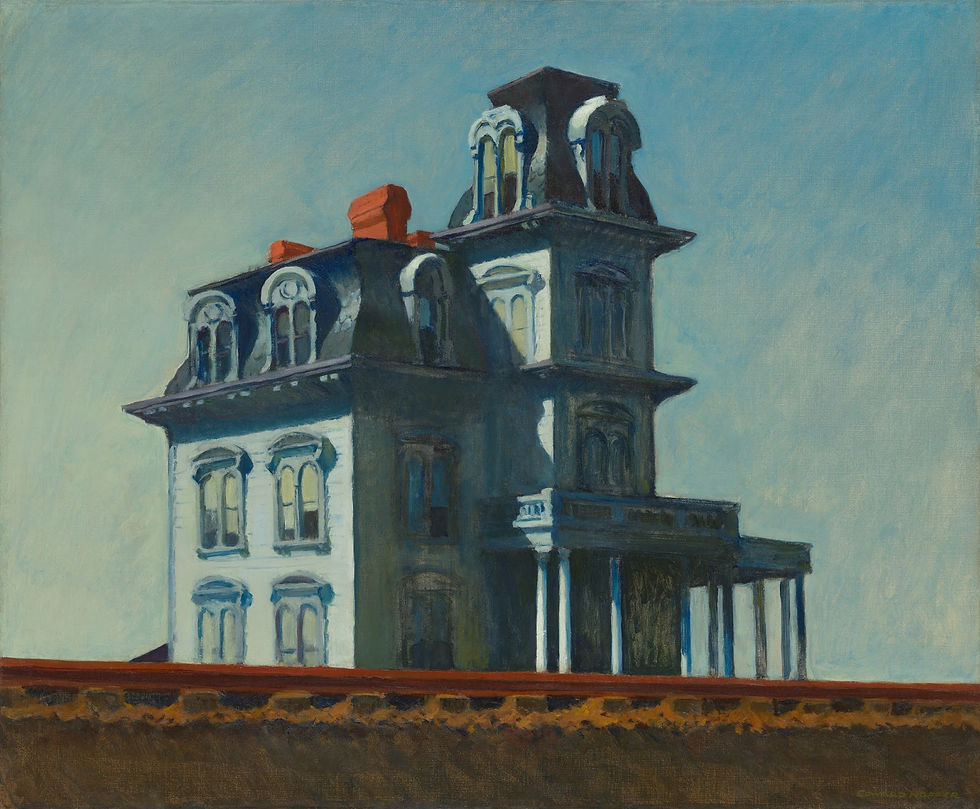
Edward Hopper is one of the best artists of the 20th century and I'm not prepared to argue that. His unique and distanced view of American life and culture instils a sense stark loneliness and acute recognition with the audience. Better known for his work Nighthawks or Office in a Small City, Hopper helped influence one of horror's cinematic masterpieces. House by the Railroad, inspired by a house in Haverstraw, in turn inspired Alfred Hitchcock's interpretation of the home of Norman Bates in Psycho.

18 Conger Avenue in Haverstraw, NY is unassuming among others on the street. But the location and the house itself drew Edward Hopper to the scene. His interpretation of the house is in keeping with his style. The architecture is definitely different, and the house in the painting is defined by his typical theme; striking solitude. It sits alone, by the railroad tracks with no station in site.
No visitors, no dwellers.
Perhaps it was this sense of isolation or security and secrecy from others that provided Hitchcock with the inspiration for his take on the Bates home.

The Bates Motel is the daddy of horror film locations for me. It looms on the hill, it oversees the murders, it enables the deception, the lies, the stories. It's the perfect space for Norman/Norma to shift and hide. It is immediately recognisable and so ingrained in modern culture. It is hard to find someone who couldn't provide a rudimentary drawing or a basic description of the Bates Home, standing over the macabre motel. It's influence is so wide that you can find this California Gothic home invite itself into a lot of other horror spaces. I would say that the Niebolt house as it appears in the film It:Chapter 1, and the house from Monster House come straight to my mind as influenced by the home.
Architectural horror is ingrained into our lives. We recognise a scary house from the moment we look at it.
"Houses...are alive. This is something we know. News from our nerve endings. It we're quiet, if we listen, we can hear houses breathe. Sometimes, in the depth of the night, you can even hear them groan. It's as if they were having bad dreams." (Rose Red, Stephen King)
Stephen King's miniseries, Rose Red, was haunted house realness, honey. The above quote resonated with me when I saw the film for the first time at the tender age of...I don't remember, but most likely I was too young. Houses do breathe. Houses do groan. And it's part of our human nature to try to humanise, to anthropomorphise everything we experience. Anything we can do to make it seem more comforting and recognisable. But often, in doing so we make our surroundings scarier, unnatural.
The miniseries is definitely worth a watch and has some exceptional stories, almost anthology feeling in it's nature. The performances are believable and the relationships are very interesting. And it has Jimmi Simpson in it!

Rose Red, (actually Thornewood Castle), is a house that needs no human assistance here. It is alive. It moves, and changes. They can never record the same number of rooms twice. Windows on the exterior move and doors ventured through are often not there on further exploration of the halls. The house saw a series of death through it's construction and then subsequent use as a family home. The living building and it's collection of spirits was, in part, inspired by Shirley Jackson's novel The Haunting of Hill House. But there was another inspiration, based in reality and rumours, which is the true Rose Red.

The Winchester Mystery House in San Jose, California is one of the most famous haunted houses in the whole of America. It's one of their most famous attractions too. It is the inspiration behind films, books, and more. The story behind the house is a sweet little ghost story. A medium told Sarah Winchester, heiress of the Winchester Rifle fortune, that the spirits of those killed by the firearms were going to haunt her. She must keep building the house to either appease the spirits or to confuse them in their chase throughout the corridors. So Sarah Winchester built her house continuously until her death.
These actions have left behind a sprawling, complicated mansion. It features doors leading to huge drops on the exteriors, staircases which lead to nowhere and rooms with upwards of ten fireplaces. And that's only a brief description of the madness. Needless to say, the myth of Sarah Winchester and the unsettling and confusing layout of the home have inspired many feelings of unease.
Following on from the Winchester Mystery House, I'd like to mention two homes based in literature. The first is The Haunting of Hill House by Shirley Jackson and, it's spiritual (if you'll pardon the pun) counterpart, Hell House by Richard Matheson.
Shirley Jackson's classic Gothic novel The Haunting of Hill House is a tale of friendship (or outright lesbian love) and ghost hunting. And by contrast, Hell House by Richard Matheson is the sexy, heavy metal parallel to Jackson's tender and delicate tale.
Both novels centre around that classic location of the haunted house. The central plot of both follows an investigative group aiming to prove, or disprove, the existence of ghosts. But where Hill House takes the tragedies of the home and allows the characters to experience the haunting mildly, Hell House screams "fuck you". It hits you with degradation, drugs, debauchery, and depictions of lesbian experiences that are a tad questionable.
It's interesting that the hauntings are portrayed in such contrasting ways. Especially given that the plots take place in such similar locations and under similar circumstances. I envisioned the houses to be almost identical in architectural style, making it easy to identify their location in the same world. They are both definitely worth a read, one after the other if you want to understand the two polar opposites of a potential haunting. I don't know how better to describe them other than telling you that The Haunting of Hill Houseis Buzzfeed Unsolved and Hell House is The Last Podcast on the Left. Hopefully that helps...
We now come to the best known, most controversial haunted but-probably-not-haunted houses in history. From horrifying true crime case to controversial novel, transcending into film, both fiction and documentary. It has sealed it's legacy in our collective history. I won't dwell long on the story behind it, for surely everyone knows a little bit about the Amityville Horror House.

The Amityville house is one of those buildings, touted as looking creepy through design alone. Before you even know it's history, those two windows like peering eyes watch you as you approach. You're sure you're going to see someone, or something, peering from behind the curtains in the attic space. The windows below, a gaping maw, ready to swallow you. If a residual haunting can take place, then the murders here would definitely contribute to this. I find that the true crime story of the DeFeo family far outweighs the supernatural "tales" of the Lutz clan. That event is factual, there is evidence of this. And I don't mean to disparage, but the paranormal should be considered a science, and the true weight of scientific evidence is in replication. This seems to be completely void in the case of Amityville. It makes for a good scary story though!
But the haunting that the Lutz' experienced was only recorded by them, and by no one else who has lived in or owned the home since. This extended period of time with no ghosts to record suggests there is no haunting at all. Or, could this be a haunting which follows one particular person? A demonic attachment to a member of the Lutz family as opposed to a residual spirit who plays their plight over and over again. My bet is on the kid who had the imaginary pig friend called Jodi. That's some classic demon kid trope right there.

112 Ocean Avenue is just a house though. A beautiful Dutch colonial home in a nice neighbourhood. But so many report the steady unease growing as they gaze upon the structure and reflect upon the horrors that did, and did not, happen within it's walls. The thing that gives this house it's mystique, rather than the true elements of horror which could have seeped into the brick work, comes from a supposed haunting that has pervaded cinema and our culture ever since.
A brief break for something more fun, the world of Haunted House attractions! Haunted attractions have a rich and fascinating history that I would love to go into detail about some day. I'm determined to make a pilgrimage to the first ever Haunted House and visit some classic of the UK at some point. It's interesting to see them develop from French theatre and creative practices to a worldwide theme park phenomena! It's nice to see horror appreciated on a wider scale like that. And in my mind nowhere does it better than, oddly enough, the happiest place on earth.

The Disney Haunted Mansions hold a special place in my heart as far as haunted houses go. I have visited both American iterations and the French version of the attraction. They are the epitome of a classic haunted house and the attractions based on them. The gentle rides are whimsical, musical, nostalgic and beautiful as well as being delightfully creepy. Their stories are classic and recognisable in the world of horror. I don't want to get into what I would give to live in any one of the Haunted Mansions.
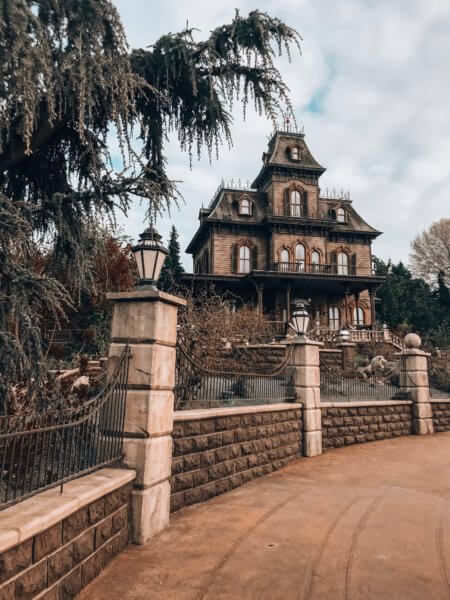
The use of classic cinema techniques and music make them one of the best rides at Disney. I hope it remains a staple of the parks as it's a classic that deserves to be experienced by generation after generation.
The difference in aesthetics of the Haunted Mansion from park to park is what makes them so appealing to me. Each one captures out to. Florida is serving up some post-colonial extra-ism. The house is grand and tells it's story well, in situ beside the river boat and across from the Wild West themes of Adventureland. The story plays out as you walk from one area to the next and see it in the distance.

California's New Orleans/plantation manor home hits hard in a historical sense. It fits well in New Orlean's square with the jazz music wafting past the small graveyard at it's side.
In Paris, a whole new take. Rather than the clean and inviting exterior of the American facades, we see the mansion as a decrepit, classic Victorian. A truly haunted house in every sense.
*chef's kiss*
Coming back to reality, the last house I want to look at is one steeped in true misery, regardless of the supernatural elements of it's history.
Classic New England architecture is a sweet spot of mine. It's unbelievable how many structures are still standing, almost proud of their horrifying history. One such building, defiant of time and of morals, is the Jonathan Corwin House, or as it's now know, the Witch house.

The Salem Witch Trials are one of the equal parts interesting and horrific epochs of American history. This was a society who survived the journey across the ocean. Who built houses from whatever materials they could find. A people who maintained some semblance of law and order. Who communicated with natives and traded (or stole) what they needed. And that these people could devolve into a puritan nightmare who believed cake with dog piss in it could determine whether a woman had fucked the devil. What the fuck is even that?

Jonathan Corwin was the head honcho of the witch trials in Salem, meaning he was the biggest prick in the bunch. His house, where some of the trials took place and where he somehow managed to sleep at night, is now a staple of the Salem tourist industry. It very much looks the part of a building in which evil deeds were committed, due in part to it's dark, black walls. But it has a sickening appeal in terms of aesthetics. I would live in it for sure. It checks a lot off of my future home list:
an association with Witches, powerful female ancestors - YES
painted in a way that it could cause neighbourhood children to run past it - YES
definitely encourage the puritan villagers to accuse me of witchcraft and ultimately put me to my untimely death - ABSOLUTELY
By no means was this a definitive list of haunted homes, or rather homes which haunt us. But it was a list of houses I think about a lot. Houses that stick with me, that I dream about. Where I am trapped within them with the very real rumours of the ghosts which might seek me out to tell their tales. I welcome any and all discourse and suggestion for further research into homes which fit into this list, and hope to one day check all in this post off of my "To Visit" bucket list!
Comments