


Reading Art: Horrible Paintings
- Aug 14, 2020
- 12 min read
Updated: Jun 6, 2022
Buckle up and join me as I discuss art history, while delving into my history with art. I have loved art since I was a wee, tiny baby. I love creating it, I love looking at it, I love critiquing it, feeling it, smelling it, touching it. When I was at school in my teens, my art class was a form of escapism. It was safe there. My teacher appreciated and supported me and I had a nice collection of friends in the class. Plus, the nearing seventy year old teacher I had the world's biggest crush on had his office in the corridor. A true blessing.

While I enjoyed creating art, the curriculum was too strict to allow true creativity. But I could unleash artistic expression in my theoretical course work. I'm better with words anyway. The thrill of diving into an artist's history and back catalogue of work is enthralling. Secondary to my love of architecture theory and critique was portraiture works. I worked this into my photography dissertation, in which I focused on using the subject's environment as a storytelling method. It was nice to be able to reference Gauguin and Jacques-Louis David alongside my own work.

The thing about art history though, is that it requires an innate ability to remember names and dates. I am not good at either of those things. It would have been near impossible for me to study art history. I rejected my offer to study history for this same reason. Entire rap verses and the lyrics to every Weird Al song, sure, you got it! But the name of a single artist unless heavily prompted, my brain won't have it. It's like classical music. I cannot remember the titles, they're too similar. Manet and Monet? Get it together, art world!
I wasn't shown anything riveting in the school curriculum that would merit my brain's long-term memory capacity. I don't remember exposure to anything that was too overt, either in style or theme. I did see plenty of tits, it's art after all. You can't go to a museum without seeing some chubby, cherubic babe laying in her boudoir, flower in hand, breasts lolling to the sides. Where someone like me can whisper under their breath the immortal phrase, "dat me".
_(33539037428).jpg)
I never got to see anything scary though. Which is a damn shame, as there is art out there that is horrifying. The classic examples of scary paintings could have been too 'overdone' for my teacher to bother showing us. Already ingrained in popular culture. A bit too obvious. It might also have been that my art teacher believed that 'A Bar at the Folies Bergére' and Dega's ballerinas were the epitome of artistic perfection. Not that either are void of artistic value, but they don't move me. So rarely was I ever exposed to artwork that gave me 'the feeling' during my studies. So little that I thought feeling emotional movement was something only pretentious people claim. It began to feel as though I were being trained to think that art was to be produced and scrutinised to a deadline.

My teacher and I were very different in our aesthetic values. We had conflicting views on what was interesting to look at. I wanted to paint thick, black outlines around everything I drew, a nod to my developing anxieties. She hated this and forced me to get rid of them. I wanted to focus on cartoons, comics, crude drawings of jokes and non-jokes, be the next David Shrigley. Instead, she had me design the menu cover for a Chinese-Mexican fusion restaurant. I toiled over it for hours, drawing dragons, butterflies, intricate mosaic tiles. Then my aunt pulled us off to Las Vegas for her wedding and I received a B grade for my forced efforts. I chose not to do a further art class. I didn't like being stifled and told what to do, I still don't.
#/media/File:Paul_Klee,_Swiss_-_Fish_Magic_-_Google_Art_Project.jpg)
An opportunity for us to bond over art presented itself so rarely with our clashing preferences. There were moments where we connected though. When I first saw Paul Klee's work, Fish Magic, I do remember her giving a little spiel about his work. I love Fish Magic. I don't like all Klee's works, but it's one of my top paintings of all time. We connected over that dark little piece. It's child like, that's the first thing I noticed. "Is it good?" I wondered. But it was, because I kept looking at it. Scouring over it, every little detail in the fish jumping out. There's a man and a clock? Why? I don't tend to find deep meaning in art of any kind, whether film or literature. I try not to look into things beyond the surface of what is shown, obvious themes, and what it makes me feel. This made me feel sad. It was joyous but dark.
#/media/File:Senecio2.JPG)
Klee's works were some of the first that gave me that feeling of uncertainty and unease that I now crave when viewing a piece. It's what I base my ultimate opinion of a work on. The desire for these feelings is not something that is shared by all viewers of art. And the feelings that were inspired in me by Klee's works are not the same others get from viewing them. But there is little doubt that they feature themes of pain and, to an extent, a kind of horror. Take, for example, Scenecio (orHead of a Man Going Senile in English). It's the Bad Moon Rising of paintings. Jolly on the surface, tension and negativity bubbling underneath.

And one of Klee's final pieces, Death and Fire, highlights this further. It is inspired by his deteriorating health and painful skin condition. He fills the piece with cryptic hieroglyphics that repeat the German word tod, death. It's here where the study of art becomes an important factor in the appreciation of a work. This painting makes me sad. I'm not sad because of the colour. I'm not sad because of the images depicted here. I'm not even sad because of the death. I'm sad because of Klee. His last few years, months, days spent in pain. You can't tell that from the piece. But I know it because I took the time to learn about the artist behind it. That is important in finding the horror in a piece, even if the visuals are terrifying on their own. There's always a reason, no smoke without fire. I appreciate a good story, so whenever I find art that appeals to me, I always try to create that story. I take hints from the visual cues, the title or the artist's own narrative.
In summary, you'll be glad, that's how I found that art can be scary. And that art can be scary in many ways. Face value imagery, deeper storytelling, and history. Although I've been exposed to horror themed imagery in many ways, classic art is one of those areas where it feels a bit naughty to get spooky. It's historical horror. Horrible. It's all the more enjoyable for that reason.
So to start (finally!) looking into paintings that evoke horror. Art that tries to tell us it's horrible. Works that have some creepy elements that induce the fear in us.

Goya and his Black Paintings
What is a greater signifier of our own fears and terrors than the act of hiding something away? If we were proud of something, joyous of it's existence and the feelings it prompts from us, we would show it to the world. But, something we fear, something that draws from our primal instincts of terror. We seek to hide it and conceal it. From us and from others.
Francisco Goya was a Spanish artist. His works fall into the romanticism movement, but towards the end of his life he took on a darker aesthetic. Most likely this was inspired by his fear of old age, madness, and his complete deafness in his later years. This terror is reflected in a collection of his works known as the Black Paintings. In 1819, Goya purchased a home conveniently named Quinta del Sordo (Villa of the Deaf). He lived there until 1823 and continued to visit until his death in 1828. On the walls of the villa Goya had painted a collection of works, which he had no intention of showing others. These paintings, from between 1819 and 1823, highlight his mental state during this time. They tell a story of his deteriorating physical, and likely, mental health. And, like the above painting Witches' Sabbath, contain overt themes of horror.
The Black Paintings are among the most haunting yet beautiful paintings I have ever seen, not in person unfortunately. I won't talk about each painting here. Instead, I'll focus on my favourites of the set and those which, to me , are the most fear-inspiring. To take these images as set, as an experience, imagine stepping into the remote house and seeing these on the walls in the dim light. Try to keep that atmosphere in your mind as we go into more detail.
#/media/File:Goya_Dog.jpg)
My favourite painting of the collection is, in a surprise twist, El Perro. El Perro is a depiction of stark loneliness. Absolute helplessness. A creature, experiencing something it doesn't have the ability to explain, unable to ask for support or guidance. The dog doesn't seem to me to be drowning or dying. It's lost. Peering into it's eyes there's the unmistakable sadness an animal can show. Not fear or anger. A hint of panic behind eyes that know there is no one there for comfort. I remember all the times I've felt lost, physically and emotionally. This is how I imagine I looked. While putting on a brave facade, trying to get it together. My eyes betrayed me, as this dog's do for him. I have an anxiety disorder and depression. I recognise this dog's eyes, I recognise the scenario. And I feel Goya knew that so well too in his final years. Fear of madness, inability to express his feelings, unable to hear the comfort of others. Lost.
.jpg)
At a close second to El Perro is Goya's painting of Saturn Devouring His Son. A grotesquely carnivorous image. Goya doesn't skimp on the themes of cannibalism, infanticide and fear of one's own aging. Goya, frail and afraid, portrays this mythological tale of Saturn. Saturn, who consumed his own children for fear of them overpowering or overthrowing his command. A fear that we all know and can relate to. Dying. A desire we all feel. To be important and recognised. While the subject matter of this painting is also covered by Rubens, Goya's interpretation of the Greek myth is far more brutal. Saturn is not a human, he is a monster. Was he a monster before the consumption of his own flesh and blood? Or did his strong desire to assuage his fears and the lengths to which he went to for this, create the monster. Is Goya's Saturn a similar being to that of the Wendigo? The gaunt limbs, wild eyes and unhinged jaw allude to a man possessed by, and in the throws of, true horror.

And the third painting of the collection I'd like to discuss, Two Old Men. Long, dark, figures stand against a pitch black background. A frailer man, white beard and hair, weathered features, clings to a cane. Behind him, an inhuman creature leans into him, intimately. He is speaking into the old man's ear. Whispering, shouting. In particular, this painting captures Goya's emotions and his coming to terms with, or refusal of, his illness, deafness and mortality. The man in front is stalked, haunted, by the individual behind him. Not a human, the ears and nose are reminiscent of gargoyles, a little bit Lon Chaney a la Phantom of the Opera. Are they to represent Goya's demons, or are they a true representation of man in Goya's eyes? A monster, reminding him of his deafness? Of the need for other's to be physically close to him, a constant show of his sickness? As human beings who fought wards and embittered him in his later life? The stoic expression of the elderly man with the cane shows pride, a resistance to the figure behind him. If this is how Goya viewed himself and those around him, it brings a hard and painful feeling to my chest. Profound loneliness brought on by your own mind. A warning for us all to live by.

Théodore Géricault
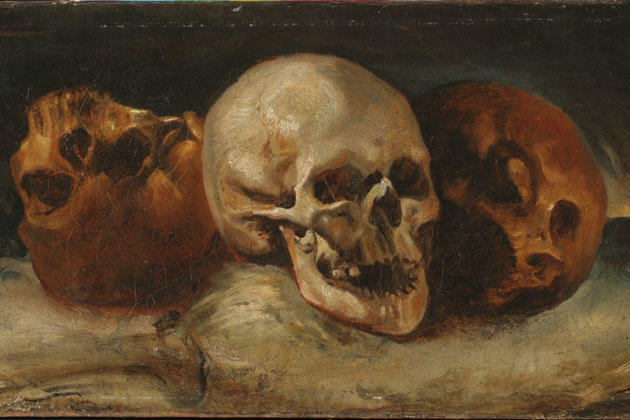
Now, to something a little bit less depressing and a bit more scientific. There are two sets of paintings by French painter Théodore Géricault that fit well within our themes of horror. The first is a collection of works that he used as preparatory studies for his larger piece, The Raft of Medusa (this is not the time nor place for me to start going off on a tangent about Dennis Nilsen, but rest assured that day will come). The second is a small group of portrait studies on patients who were deemed insane. Géricault himself, having died young, was a short lived master of romanticism. But his desire for accuracy and visual realism encouraged him to study oft neglected and nasty subject matter.

As the study of a shipwreck, The Raft of Medusa, as shown above, required a degree of anatomical accuracy to prove as realistic as possible in it's portrayal of the tragedy of lives lost at sea. To capture this, Géricault worked in a morgue, capturing the stark realism of death itself. He was not someone who shied away from the inevitable end that all humans come to. He worked with death in many other ways, capturing heads, limbs and torsos for artistic value. These paintings stand out as scientific, yet emotional. While Géricault may have tried to claim his position as the viewer, he managed to display raw feeling in the faces and bodies of the dead.

Sometimes, Géricault captured the matter-of-fact way that those who deal with death on a daily basis tend to treat the bodies. Anatomical Pieces is a title that so succinctly describes the subject matter. A scattering of limbs lay on the ground, covered by a sheet. This is the kind of scene a person may only encounter in a disaster scenario. Where bodies line the streets and body parts are strewn carelessly.

And, on occasion, Géricault brings life to the dead through facial expression. I can see death in The Severed Heads, and to his painting Head of a Drowned Man. I can almost tell what it's going to feel like. True artistic ability is capturing a personality, an emotion, or a narrative. Géricault is able to do that with a corpse, incapable of expressing any desires or feelings. Unable to suggest a place for their portrait to be taken that suggests their status or history. Géricault captures this with a blood stained sheet. Depicting the horror, or peace, that's coming to us all.
Géricault's family had a long history of insanity, which most likely inspired his portraiture study of the insane. Made for a psychiatrist, Géricault produced ten portraits of people who were being treated for various mental illnesses of the time. The paintings give vague insights into the supposed illness of the subject. But it is important to recognise that these descriptions are unhelpful in a modern sense as we have progressed in our understanding of human behaviour and mental illness.


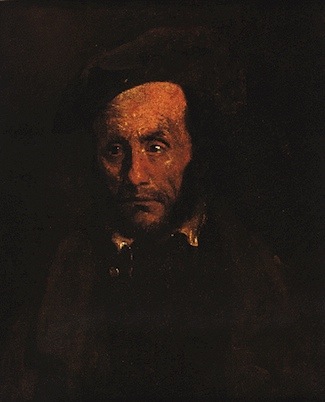
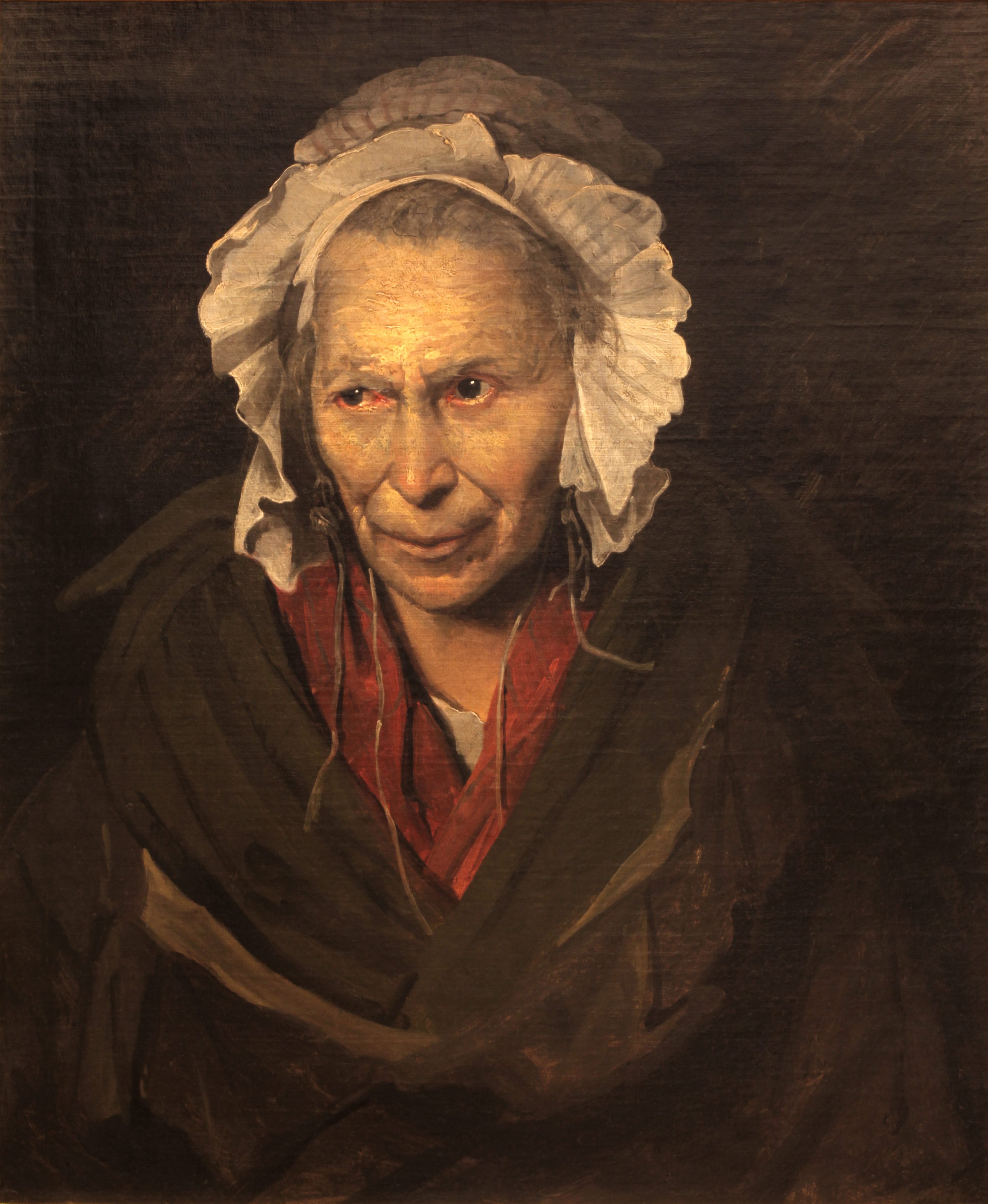

The above selection of images highlights Géricault's ability to look into the soul of his subject, and show his mastery of portraiture. It's undeniable that there is a horror in staring into the soul of someone deemed insane by their society and the tangible sadness of the expressions makes this study difficult to look at. How easily I could have been one of these paintings had I expressed myself and my emotions in Géricault's society. How relatable this is to any of us, to be captured in a moment of weakness and gazed upon by a pervasive stare.
Dragan Bibin's Human Condition
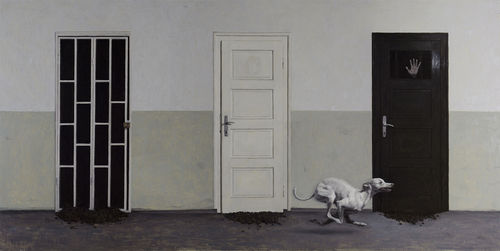
The last paintings I'd like to discuss for now are by contemporary Serbian artist, Dragan Bibin. Particularly, I'd like to focus on his work which falls under his heading of The Human Condition. I stumbled upon Bibin's work quite a while ago, and return to it for inspiration and the visual heebie-jeebies frequently. His work is virile, strong, devoid of colour, vivid. His interpretation of Goya's previously mentioned El Perro in his work Refuse Heap is a strong image.

Featuring a continuing cast of dogs, doors, windows and cloth, Bibin captures my greatest fear in it's entirety. The unknown. It speaks to me on a deeply personal level. I love dogs, and I love my dog more than anything in this world. I want to love him, and protect him. My fears stem from darkness, not knowing what lurks in it. From the Resident Evil video game franchise, not knowing what waits for me behind a door. From the intense desire to know what someone, a human or animal, is thinking, not knowing what to anticipate. I can attribute a lot of my fears to my history and my anxiety disorder, and I've never been able to produce my own depiction of how it feels. It's too personal. But Bibin get as close as I could ever hope to with this collection of works.

It is shown in his perfectly titled Deimos, meaning dread. Every time I look at this picture, I'm caught up for a few minutes. Repeating unanswered and unanswerable questions over and over again. Trying to comfort myself by figuring out what's happening. Where does the door go? What's behind the door? What's in the darkness? Why is the dog staring? Fear? Dread? Anticipation? Is he afraid? Is he making that low growl a dog on high alert makes? Or is he whining, fearful? Am I reading this wrong? Is this a painting about love? Is the dog waiting for his owner? Am I, by jumping to conclusions of fear, exhibiting this exact human condition that Bibin seeks to display? It would settle my mind to know some answers, but where is the fun in that? If I knew what the dog was waiting for, this painting wouldn't have the same hold on me.
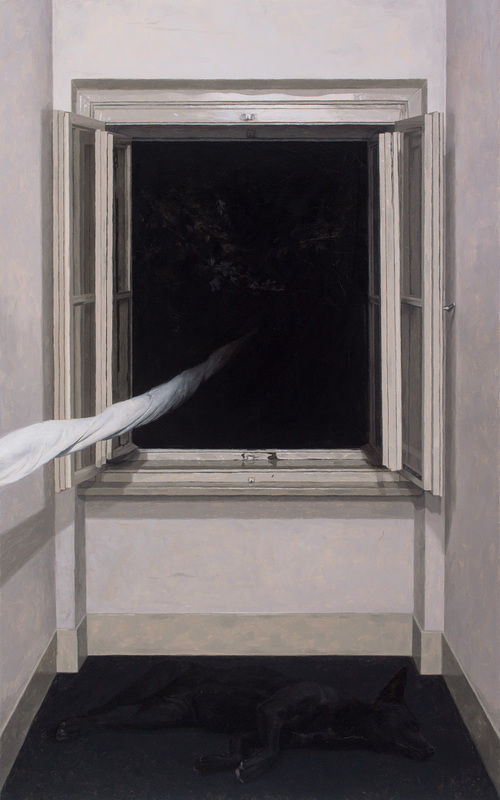
The unknown. Something could be outside of that window. Something could be in the dark. And, we know that something is there. The tension of the fabric is real, not imaginary or mystical. Physics plays a part in the tension here. Are we, the viewer, holding the fabric? Are we pulling against something out there, the other. Or are we between two horrors, one pulling from behind us, one in front of us, both unseen. Why am I afraid, and yet, sleeping below the danger, in the line of fire, is a dog? Unaware of his position, or unbothered by it.
I implore you to go and look at the other paintings in this collection, and Bibin's other collections. Especially if you have enjoyed this selection of works which I hope have given you the same tingling, chilling feeling as I get when I look at them. And I do look at them quite regularly. I'm a sucker for punishment.


Comments